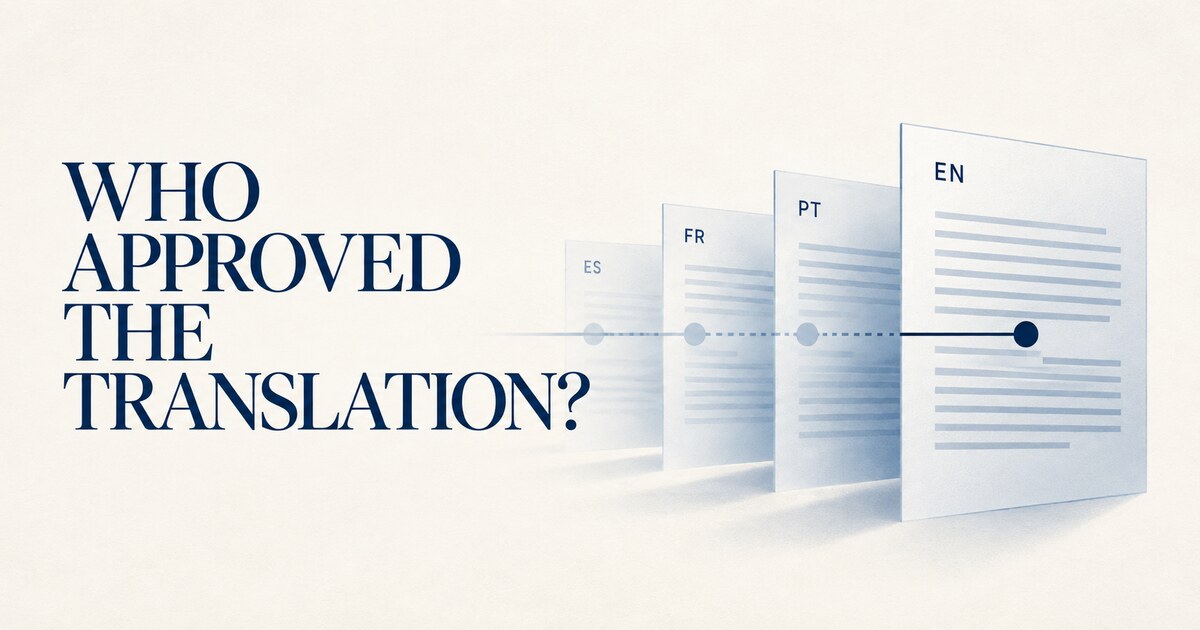
A source text has been researched, fact-checked and approved by an editor.
Then it is translated by AI.
The translation is fluent. A person checks the grammar, corrects a few awkward phrases and sends it for publication. The target-language reader receives a polished text bearing the authority of the original.
But what, exactly, was approved?
The source was. The translation may not have been.
That distinction has acquired new significance under Article 50 of the EU AI Act. It has also become more complicated as providers introduce technical methods intended to make AI-generated text detectable. Human review, machine-readable provenance and editorial responsibility now meet at the same point: the version that ultimately reaches the reader.
Translation makes that meeting point unusually difficult to see.
What Article 50 changes
Article 50 creates different transparency obligations for providers and deployers of AI systems. Among them, providers of systems that generate synthetic text must make AI-generated or manipulated outputs detectable in a machine-readable format, subject to the conditions and exceptions established by the Regulation. Deployers, in turn, must clearly disclose certain AI-generated or manipulated texts published to inform the public on matters of public interest.
The disclosure rule is not absolute. The Regulation provides an exception where the AI-generated content has undergone human review or editorial control and a natural or legal person holds editorial responsibility for its publication.
Those terms matter. The European Commission’s guidance describes human review as a deliberate examination of the substance by people who possess relevant knowledge and professional judgement. Editorial control requires practical authority to approve, alter or reject the substance of the text. Superficial, formal or procedural checks—such as spell-checking or grammatical correction—do not meet that standard. Editorial responsibility, moreover, means ultimate legal responsibility for publication.
The relevant category, then, is not simply human involvement.
A person may appear somewhere in a workflow without examining the substance, having authority to intervene or accepting responsibility for what is published. “Human in the loop” tells us that somebody was present. It does not tell us what that person knew, decided or could prevent.
Article 50 has applied since 2 August 2026. Yet it does not expressly answer the particular question raised by multilingual publication: when a substantively reviewed source is translated, does that review extend to the target text?
It should not be assumed that it does.
Translation is another publication decision
Translation changes the text on which judgement must operate.
That change is not limited to vocabulary. A translation may alter the degree of certainty in a statement, the relationship between cause and consequence, the attribution of an opinion, the scope of a legal qualification or the force of a warning. A factual proposition may remain recognisable while becoming narrower, broader or more categorical. A culturally familiar formulation may acquire an unintended institutional meaning in another jurisdiction.
None of these problems has to result from careless work. They arise because languages organise meaning differently and because every translation requires decisions.
Consider the simplest workflow:
Human-approved source
↓
AI translation
↓
Published target text
The editor who approved the source examined one text. The target audience reads another. If no qualified person examines whether the facts, meaning and consequences survived the language change, the approval chain contains a gap.
Proofreading does not necessarily close it. Neither does correcting terminology in isolation. A target text can be grammatically clean and terminologically consistent while still changing the proposition for which the publisher assumes responsibility.
This is why translation is not merely a technical stage between approval and distribution. The translation is another publication decision.
Human involvement is not human review
Once that distinction is recognised, the usual workflow labels become insufficient.
What did the human actually do?
Did the person translate, post-edit, proofread, fact-check or rewrite? Did they compare the target with the source? Did they have access to the evidence on which the source relied? Could they reject the output, or were they expected only to correct it? Did they possess relevant subject-matter knowledge? Did anyone formally approve the final target-language version?
These are not interchangeable functions.
A linguist may be responsible for semantic and cultural accuracy without being authorised to validate the underlying facts. A subject-matter expert may confirm the facts without being able to identify a shift in modality or legal effect between languages. An editor may hold final authority but lack access to the source language. Substantive review in multilingual publishing may therefore require more than one form of expertise—and a workflow that makes their respective decisions visible.
The meaningful question is not whether a human touched the text. It is whether someone with the necessary competence and authority deliberately examined the version that reached the public.
Can provenance survive translation?
On 5 October 2026, OpenAI announced its approach to text provenance under the EU rules. Its text watermarking technology, textGrain, introduces an invisible statistical signal through a model’s word choices. A detector then looks for that signal when assessing whether a passage contains an OpenAI watermark.
The approach illustrates both the value and the limits of technical provenance.
In OpenAI’s published evaluations, replacing 10% of the words in a 400-token passage with synonyms reduced detection from approximately 92% to 66%. Replacing 25% reduced it to 17%. Those figures concern controlled editing rather than translation, but the implication is clear: a signal embedded in patterns of word choice can be weakened when those choices change.
Translation does more than replace a minority of words. It reconstructs the passage in another linguistic system. OpenAI explicitly acknowledges that the absence of a detected watermark does not establish human authorship: AI-generated text may have been edited or translated enough for detection to become unreliable.
That produces a striking asymmetry. A human translator may write every word of the target text while working from a source generated by AI. The final version may contain no reliably detectable signal, although the origin of the source remains relevant to decisions about verification, disclosure and publication.
Now reverse the workflow:
Workflow A
- AI-generated source
- Human translation
- Human revision
- Published target text
Workflow B
- Human-written source
- AI translation
- Human post-editing
- Published target text
Both workflows end with human involvement. Both may produce fluent target texts. But the origin of the content, the nature of the human contribution and the object of review are different.
The legal classification of any particular workflow will depend on its facts, the system’s function, the nature of the output and the publication context. The AI Act does not provide a universal rule declaring every AI-assisted translation subject to the same obligation. The broader professional problem nevertheless remains: a language change can obscure the history of a text precisely when that history still matters.
Provenance, approval and responsibility
Part of the difficulty comes from treating three different questions as though they were one.
Provenance
Provenance asks where the text came from. Which systems and people participated? Was the source generated by AI, the translation generated by AI, or both? What transformations occurred before publication?
Approval
Approval asks who examined and authorised a particular version. Was the source approved? Was the translation compared with it? Was the target text substantively reviewed in its own communicative and legal context?
Responsibility
Responsibility asks who answers for what reached the reader. Who had the authority to stop publication? Who accepted the consequences of the final wording? Who can explain why that version was considered fit for use?
A watermark can contribute evidence about provenance. It cannot answer the other two questions. OpenAI is explicit that its watermark does not measure human contribution, determine ownership, verify accuracy or establish responsibility.
Nor can the disappearance of a signal erase the history of the workflow. If provenance technology becomes unreliable after translation, publishers need other means of preserving the relevant record: content lineage, workflow metadata, documented review stages, version-specific approval and a clear allocation of responsibility.
What should cross the language boundary, then?
The watermark, where technically possible. Provenance information, certainly. Disclosure, where legally required or editorially appropriate. But above all, responsibility for knowing how the text originated and for determining whether the translated version can be published with the same authority as the source.
The language professional’s role
This is where the role of the translator or linguistic reviewer becomes more consequential, not less.
The language professional should not be treated as the person added at the end to make AI output sound better. In a responsible workflow, that professional helps determine whether meaning, facts, qualifications, tone and foreseeable consequences survived the passage between languages.
That does not mean transferring all legal or editorial responsibility to the translator. Responsibility must correspond to actual authority, access and expertise. A professional cannot meaningfully approve what they were not allowed to question, verify or reject.
It does mean recognising that target-language approval requires judgement directed at the target text. The person performing it must understand the purpose of the publication, the relevant risks and the decisions already made upstream. Where necessary, linguistic review must connect with factual, legal or editorial review rather than substitute for it.
Only then can someone responsibly say:
Yes. This version can carry the same responsibility as the original.
Responsibility has to travel
Technical provenance will improve. Detection methods may become more robust, interoperable and resistant to transformation. Yet no watermark can decide whether a translated statement remains true, whether a legal qualification survived intact or whether the final wording deserves the authority attached to the source.
Those are questions of judgement and governance.
The system may be automated. The accountability never is.
Approval does not automatically travel with the source. Provenance may not survive translation. Responsibility has to.
So before asking whether a translation was human-reviewed, we should ask something more precise:
Who approved what ultimately reached the reader?
Primary sources
- Regulation (EU) 2024/1689 — Artificial Intelligence Act, Article 50
- European Commission — Transparency obligations under Article 50 of the AI Act
- OpenAI — Our approach to EU text provenance rules, 5 October 2026
This article provides professional analysis for informational purposes and does not constitute legal advice.